

Most organisations that end up with a poor security vendor didn’t make one big mistake. They made a series of small ones during procurement, and didn’t find out until something went wrong.
The security market in India is large and unevenly regulated in terms of quality. There are credible agencies with proper training programmes and compliance in place. There are also vendors who will say the right things in a proposal and cut corners the moment the contract is signed.
Telling them apart from the myriad commercial security company India requires knowing what to look for. These are the five mistakes that come up most often.
Choosing on Price Alone
This is the most common one, and the most expensive in the long run.
A low-cost contract for private security services almost always reflects something, be it underpaid guards, minimal training, high turnover or corners cut on background verification. Sometimes all of these at once.
The guards who show up under a cheap contract tend to leave quickly, because they’re not being paid properly. That means your facility is constantly covered by people who are new to the site. Access control weakens. Familiarity with regular staff and contractors doesn’t build. And when something actually happens, the response reflects the preparation that went into the deployment.
A single significant incident, such as an internal theft, a liability dispute, or compliance failure, typically costs more than the annual savings from the cheaper contract. That comparison is worth running before you sign, not after.
Accepting a Generic Deployment Plan
Every commercial facility has a different risk profile.
A corporate IT campus in Bengaluru and an industrial manufacturing plant in Pune have almost nothing in common from a security standpoint. The access patterns are different, the assets are different, the shift structures are different. And what guards actually need to do day to day is completely different.
A credible commercial security company India operates by doing a site-specific assessment before proposing anything. That means:
- a physical walkthrough,
- a review of access-control gaps,
- an evaluation of surveillance coverage,
- and a look at the specific vulnerabilities of your industry and layout.
The deployment plan that comes out of that assessment should reflect your facility specifically.
If a vendor is sending you a quote before they’ve visited the site, they’re quoting a standard package. The blind spots unique to your facility will remain blind spots.
Underestimating Training Quality
Guards are the people who respond when something goes wrong. What they do in those first few minutes, whether they handle it correctly or make it worse, depends entirely on how they’ve been trained and how recently.
Agencies that invest in training run structured pre-deployment programmes, operate through certified institutes, and schedule regular refresher courses after deployment. Agencies that don’t will still describe their guards as trained.
The difference shows up in real-world incidents: fire safety response, medical emergencies, and conflict de-escalation under pressure. Guards who have rehearsed these scenarios perform consistently. Guards who haven’t tend to freeze or improvise.
When evaluating a commercial security company India, ask specifically about the pre-deployment curriculum, the institute it’s run through, and when guards deployed at comparable sites last underwent a refresher. If those answers are vague, the training programme probably is too.
Overlooking Technology Integration
Manual guarding without any digital support creates coverage gaps that are easy to exploit and hard to detect. No audit trail on visitor access, no verified patrol coverage, no centralised view of what’s happening across the site in real time.
Professional private security services integrate tried-and-tested tools into the deployment, including but not limited to:
- GPS-tracked patrolling apps
- Smart CCTV surveillance
- Incident reporting software
… all of which feeds into a 24/7 Security Operations Centre.
The technology doesn’t replace guards. It makes their work verifiable and gives supervisors visibility they can actually act on.
The question worth asking, then, is how the technology connects to the response structure. A camera system with one monitor is just an evident collection. An SOC that alerts supervisors who can coordinate on-ground response is operationally useful. Ask how that loop actually works before accepting claims about digital integration at face value.
Skipping Compliance Verification
This one is straightforward but frequently skipped. Any private security agency in India operating legally needs valid PSARA licences specific to the state where your facility is located. A licence from another state doesn’t apply. Expired licences are more common than clients realise.
Statutory compliance matters for the same reason. Agencies that aren’t paying ESI and PF correctly or meeting minimum wage requirements tend to have the guard quality and retention problems described above.
And if a labour dispute arises, the liability doesn’t stay with the vendor. It can transfer to the client. So:
- Ask for the state-specific PSARA licence and verify it directly through the relevant state portal.
- Ask for evidence of statutory compliance.
A credible commercial security company India will provide both without making it difficult.
Final Thoughts
As we’ve discussed above, these five mistakes are avoidable. A commercial security company India that can demonstrate proper licensing, a structured training programme, site-specific planning, and leverage human-first technology is a different proposition from one that can only offer a competitive price. Because the gap between the two tends to become visible under pressure. Identifying it before you sign is considerably easier than dealing with it afterwards.
MSF Addresses These Gaps Directly
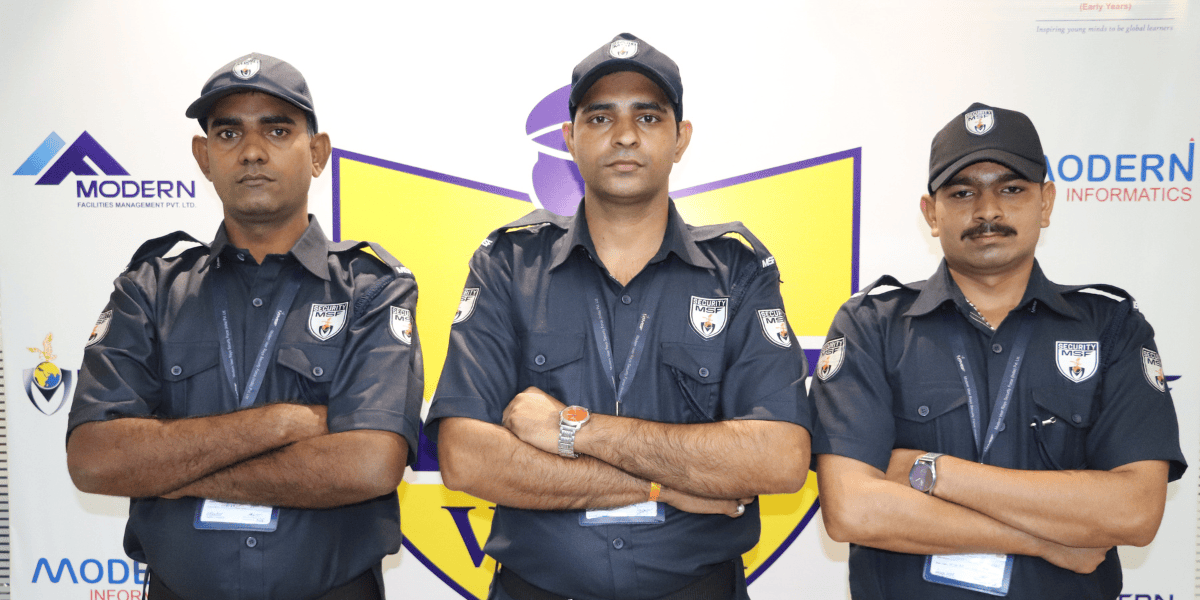
At Modern Veer Rays Security Force (MSF), we address the issue of variable personnel quality through our own PSARA-compliant training institute, ensuring that every guard meets a rigorous pre-deployment standard.
Our 24/7 SOC supports on-the-ground deployment with centralised monitoring, and our background verification process includes police checks, address verification, and employment history checks.
MSF deploys across corporate IT campuses, industrial facilities, and commercial properties: environments with vastly different requirements that we address through site-specific assessments rather than standard packages.
For organisations evaluating a private security agency in India based on documented compliance and operational depth, Modern Veer Rays Security Force is worth including in that process.
FAQs
Q. What are the real costs of hiring an unverified private security agency in India?
Apart from the obvious risks – theft, property damage, incidents that a better-prepared guard might have prevented – there are legal and financial exposures that organisations often don’t anticipate.
Think about it. If an agency is operating with non-compliant labour practices and a dispute arises, liability can transfer to the client. Fines for labour law violations, legal costs from incidents involving unvetted personnel, and the operational disruption of replacing a vendor mid-contract all add up.
The cost of verifying compliance upfront is minimal compared to any of those outcomes.
Q. How do concierge security guards differ from standard commercial security personnel?
The role is a hybrid of access control and client-facing service.
Concierge guards handle visitor management and greet clients while maintaining the same access verification and threat awareness as standard security personnel. The difference is in how they interact with people, professionally and without creating friction.
In corporate environments where visitors form impressions of the organisation through their first point of contact, the quality of that interaction matters. And it requires specific training beyond physical security readiness.
Q. Why is a site risk assessment necessary before deploying private security services?
Because a deployment plan built without one is based on assumptions rather than your actual facility.
A proper assessment physically maps surveillance blind spots, checks access point weaknesses, identifies high-value asset locations, and evaluates perimeter exposure. That information drives guard placement and access protocols.
Without it, the deployment reflects what the agency typically does rather than what your site needs. That’s where coverage gaps tend to appear.
Q. How does technology make commercial security guards more effective?
It extends what they can cover and makes their coverage verifiable.
Modern pattern-recognising cameras can detect anomalies in areas a guard can’t continuously monitor. GPS-tracked patrolling apps confirm that routes are being covered and not assumed. A centralised SOC provides supervisors with real-time visibility and enables them to coordinate a response when needed.
Guards working within that structure respond to verified alerts with current information, which is a different level of effectiveness than responding to a report after the fact.