

Security is unforgiving that way. One missed moment, one lazy assumption, and the damage is already done. It doesn’t matter whether you’re guarding a glossy corporate tower in Mumbai or a quiet but critical data centre in Delhi. The standard has to hold. Every hour. Every shift.
Consistency is the objective measure of quality, not size or marketing. Not how many uniforms show up on day one. Holding the position of India’s No 1 security agency takes more than scale. It takes discipline baked into the system: clear rules and the willingness to say no to shortcuts, even when no one is watching.
Many businesses have learned this the hard way. Guards posted, gates covered, boxes ticked. And yet something feels off. Because the best security guard agency isn’t built on “warm bodies”. It’s built on training that actually prepares people, technology that supports them, and compliance that doesn’t crack under scrutiny.
This is what separates serious operators from noise. Leaders in top security services know how to scale without diluting quality. Thousands of sites across different cities and risk levels, all under the same standards. It’s designed that way.
Rigorous Training and Specialised Institutes
Training is where everything either comes together or falls apart. In serious security work, quality is built early and deliberately, then reinforced over time. India’s No 1 security agency gets this at a fundamental level. A guard is only as good as the preparation behind them, and there’s no shortcut around that truth.
That’s why the strongest operators don’t outsource training and hope for the best. They run their own government-certified, PSARA-compliant training institutes. Control the input, control the outcome. A good security agency treats training like core infrastructure.
The focus goes well beyond basic patrolling. Guards are trained to follow fire safety protocols, not just point to extinguishers. First aid is drilled until it’s instinctive. Modern screening equipment isn’t treated like a prop but as a tool that needs confidence and precision. Alongside this, there’s a strong emphasis on soft skills, including communication, de-escalation, and reading the room—these matter when you’re managing crowds or stressed employees.
Then comes domain-specific preparation: banking environments, aviation terminals, high-stakes zones where mistakes don’t get second chances. Guards are trained on the rhythm and risks of each setting before they ever set foot on site.
By owning the training pipeline end-to-end, an agency can deploy people across factories, offices, or transport hubs and still know exactly what standard they’re operating at. That’s how top security services scale without losing shape. And refresher training keeps even experienced guards sharp, because threats evolve and complacency is always waiting.
Technology-Enabled Supervision
Training enables guards to act. Technology ensures the ability is actually used. Once operations scale, supervision can’t rely on people checking on people. To India’s No 1 security agency, oversight has to be built into the system.
A serious best security guard agency treats technology as a force multiplier. Patrols are tracked through GPS and geofencing, so routes are followed. If a checkpoint is missed, the system flags it instantly.
Reporting has moved on, too. Paper registers slow everything down and hide mistakes. Guards now log incidents through mobile apps, upload photos, record handovers, and leave behind a clean digital trail. Clients don’t have to guess what happened. They can see it, time-stamped and searchable.
All of this feeds into a central command centre that never sleeps. A 24/7 SOC monitors activity across sites and steps, intervening in real time when anomalies are detected. Guards on the ground aren’t operating alone. There’s always context, backup, and escalation ready. Such a backbone enables top security services to scale without losing control.
Absolute Statutory Compliance and Integrity
Compliance is one of those things people only notice when it’s missing. In security, that gap shows up fast and usually at the worst possible moment. India’s No 1 security agency treats legality as armour, for itself and for the client.
The industry still has plenty of unorganised players cutting corners quietly. That’s where risk creeps in. The best security guard agency builds a hard line around compliance so there’s no grey area to exploit. PSARA licences are valid on a state-by-state basis and are not borrowed or outdated. Training and vetting comply with what the law requires.
Labour laws get the seriousness. Wages are paid on time. ESI, PF, and GST are part of the structure. Add ISO standards like 9001 and 45001 into the mix, and you get systems that hold up under scrutiny.
What is often overlooked is how deeply this affects performance on the ground. When guards are paid fairly, appropriately insured, and treated with respect, they stay. Attrition drops. Familiarity with the site grows. Motivation improves. The person standing at your gate isn’t new every few weeks.
For India’s premier security agency, integrity is building a workforce that’s alert and invested. Ethical operations don’t slow security down, but make it stronger.
Proactive Risk Audits and Customisation
This is where security either becomes thoughtful or stays lazy. Generic guarding looks fine on paper, but real sites don’t behave like templates. Every facility has its own blind spots and pressure points. India’s leading security agency understands that consistency doesn’t come from repeating the same plan everywhere, but from repeating the same thinking process.
A security provider starts by asking uncomfortable questions. Where are the weak points? Which entry points get taken for granted? What happens during shift changes, peak hours, or unusual events? That’s what a risk audit is about. Mapping vulnerabilities in fencing and access protocols before someone else discovers them for the wrong reasons.
From there, things get specific. Site-Specific Standard Operating Procedures (SSOPs) are instructions that make sense on that ground. How to manage a VIP arrival without chaos. What to do if there’s a chemical spill, not in theory, but in that building.
Then comes sector logic. An IT park doesn’t think like a mall. A factory doesn’t move like a corporate office. Premier security services adapt to these differences instead of flattening them. Data privacy, crowd flow, and asset movement — each demands a different response. After all, leading security providers never wait for incidents to prove a point. It’s quietly closing gaps before they get noticed!
MSF: The Blueprint of India’s No 1 Security Agency
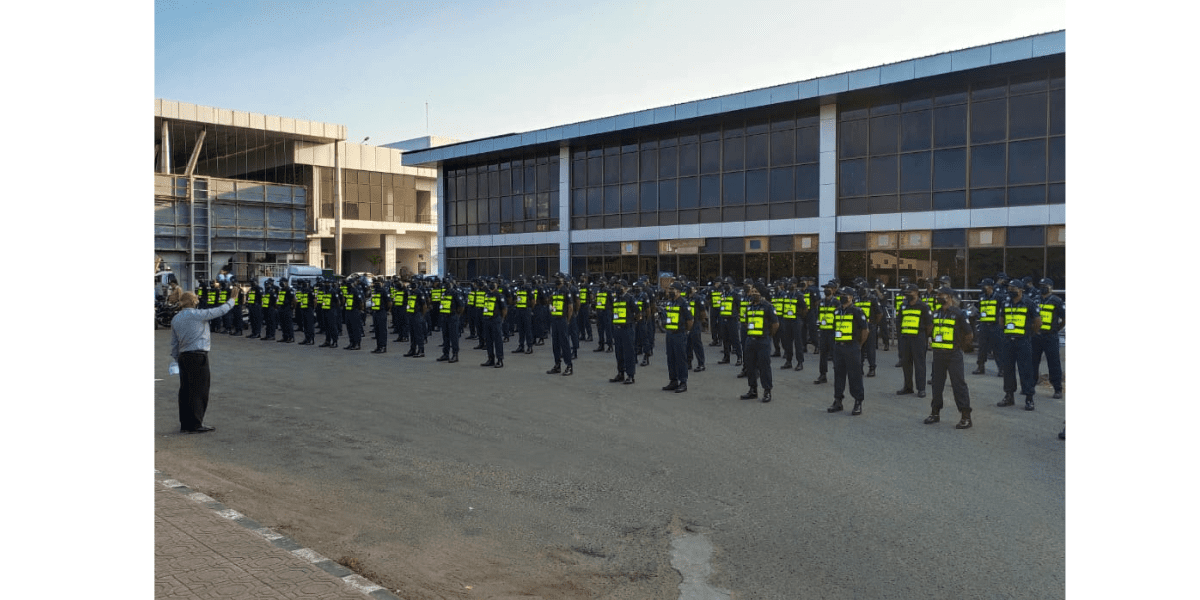
Modern Veer Rays Security Force (MSF) is the definitive benchmark for India’s leading security provider, embodying the four pillars of excellence through four decades of unwavering service. With a massive workforce of over 75,000 trained professionals and a presence across 742 districts, MSF has scaled its operations while maintaining the highest service standards.
- Since 1984, MSF has secured critical infrastructure, including 35% of India’s major airports and leading financial institutions.
- We operate our own PSARA-certified training institute in Mumbai and a state-of-the-art 24/7 National Command Centre that monitors over 6,000 sites in real time.
- As a highly recognised, ISO-certified security company, we maintain a “Zero Litigation” status, ensuring our clients have absolute peace of mind regarding legal and ethical compliance.
Modern Veer Rays Security Force combines the human intelligence of elite, on-site guarding with cutting-edge security services, and in doing so, we remain the most trusted name in the industry.
Whether it is the best security agency’s support you need for a single site or a nationwide network, MSF provides the scalable, high-quality protection that has made it India’s No 1 security agency.
FAQs
1. What’s the real difference between armed and unarmed guards, and how do I know which one I need?
Most sites don’t need weapons to be secure. Unarmed guards are well-suited for offices, retail spaces, campuses, and residential properties, where the primary focus is visibility and access control.
Armed guards are a different category altogether. They’re trained and deployed only in high-risk environments such as banks, cash-handling operations, or executive protection. A responsible provider, especially one operating at the level of India’s No 1 security agency, won’t upsell force. They’ll start with a risk assessment and recommend only what actually fits your exposure.
2. What happens if a guard doesn’t show up for a shift?
This is where scale matters. Smaller agencies scramble. Larger, well-run ones plan for it. The best security guard agency maintains a trained reliever pool, so absences don’t turn into blind spots. If someone is sick or on leave, a replacement is dispatched immediately. Posts stay covered. Operations don’t stall. You often won’t even notice the switch, which is precisely the point.
3. Do private security guards have the authority to arrest someone?
Not in the way police do. Private guards aren’t law enforcement, and they shouldn’t pretend to be. That said, under India’s legal framework, guards can detain someone committing a serious offence in their presence and hand them over to the police. Their real value is in prevention and containment. Top security services focus on stopping situations from escalating in the first place.