

Security technology has improved significantly over the last decade. Cameras are sharper, access control systems are faster, and AI-assisted surveillance can flag anomalies before a human monitor would. None of that changes the fundamental limitation: technology detects, but it can’t act.
A camera recording an intruder at 2 AM is useful evidence. It’s not a response. That gap is what manned guarding services exist to fill, and it’s why the technology-versus-people debate misses the point. The question isn’t which one to choose. It’s how to make them work together properly.
What Technology Can’t Do on Its Own
Digital access control can deny a credential. It can’t read the situation when someone tailgates through behind an authorised employee. Automated digital surveillance can flag movement in a restricted area. It can’t tell the difference between a contractor who took a wrong turn and someone who has been watching the site for three days.
Manned guarding services in India at the professional end train guards specifically to make those judgements in real time. To assess context, ask the right questions, and handle the interaction without escalating unnecessarily.
Algorithms don’t manage people well. Trained guards do. And in high-footfall environments like corporate campuses or industrial facilities with regular vendor traffic, that human judgement is being exercised constantly, not just during incidents.
The other thing technology can’t do is physically intervene. A fire needs someone to respond to it. A medical emergency requires someone with first-aid training to be on the scene before an ambulance arrives. An aggressive situation requires someone present to de-escalate it. These are the moments where the absence of manned guarding services becomes immediately obvious.
Real-Time Judgement Under Pressure
Experienced guards read environments in ways that are difficult to systematise.
They notice when a vehicle has been parked near a loading bay for longer than usual. They recognise that a person asking to be buzzed through isn’t someone they’ve seen before, even if the credentials check out. These observations come from familiarity with the site and attention to what’s normal, neither of which a camera provides.
It’s also where soft skills matter practically, not just theoretically. De-escalation is a real capability. A guard who can talk down a tense situation at the gate, be it a frustrated delivery driver or a visitor who’s been turned away, without it becoming a confrontation is protecting the organisation’s reputation as much as its perimeter.
Manned guarding services in India that invest in this training produce guards who handle these interactions well. Those that don’t produce guards who make them worse.
Emergency Response Before External Help Arrives
In a real emergency, the first few minutes are what determine the outcome. Local police, fire services, and ambulances all have response times. Guards are already on site.
A guard trained in evacuation protocols can get people moving before the alarm system has finished cycling. A first-aid-certified guard can stabilise someone while the ambulance is en route. 24/7 manned security services mean that night shift and weekend coverage aren’t gaps. Someone is present and accountable regardless of the hour.
This is one of the harder things to evaluate during procurement because it depends on training quality rather than headcount. Ask specifically what emergency training guards have received and how recently. The answer reveals more about the deployment than the staffing numbers do.
Visible Presence Changes Behaviour
A camera is passive. People know it. A uniformed guard who is paying attention is a different proposition entirely. The deterrence effect of visible, engaged manned guarding services is real and measurable. Facilities with consistent professional guarding see fewer attempted breaches than comparable sites without it.
This isn’t about imposing an intimidating presence. A professional guard who handles access control calmly creates an environment where the rules are visibly enforced. That has a different effect on behaviour than a camera mounted in a corner. Most people who think about testing the perimeter reconsider when someone is there to notice and respond.
How Guards and Technology Can Work Together
The setup that actually works is one where technology extends what guards can cover and guards act on what technology flags.
Smart surveillance equipment monitoring a large perimeter gives guards intelligence they couldn’t generate on their own. GPS-tracked patrolling apps verify that routes are being covered and create an audit trail. Digital incident reporting feeds data into a command structure that can coordinate response across multiple sites.
24/7 manned security services operating within this kind of integrated setup respond faster and more accurately than either element would alone. When a camera flags an anomaly, the guard gets the alert and can respond with context. When a guard logs an incident, it goes into a system that supervisors can act on, rather than into a paper report that nobody reads until morning.
Put simply, the technology needs to support the deployment. Manned guarding services will remain the part that acts.
MSF Provides Manned Guarding Services Backed By National Infrastructure
The argument for manned guarding services has always been straightforward: technology gives you information, guards give you response. The two work better together than either does alone. What’s changed is that the link between them has become more technically capable, whether through better surveillance, improved communication tools, or enhanced overall monitoring infrastructure.
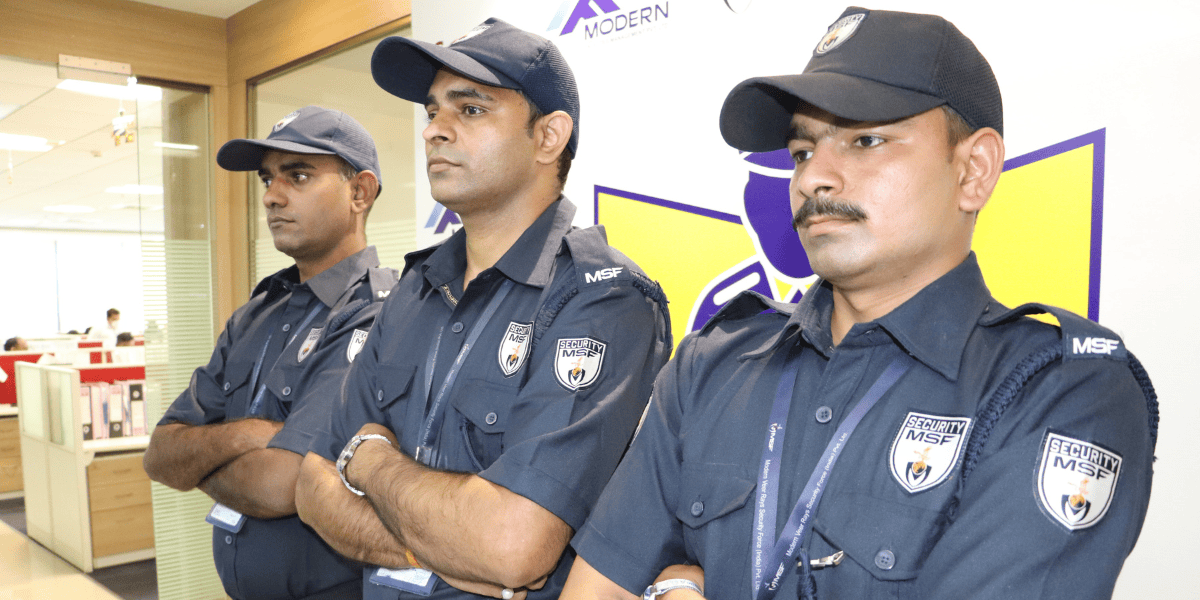
Modern Veer Rays Security Force (MSF) deploys over 70,000 trained professionals across the country and operates a 24/7 National Command Centre that provides real-time oversight for client sites. Our training runs through a Maharashtra State Government-certified institute, which standardises what guards know and can do before they’re deployed.
MSF integrates physical guarding with centralised monitoring: access control, surveillance, and incident reporting all feeding into a command structure that supports on-ground personnel rather than operating separately from them.
For businesses and organisations looking at manned guarding services in India for corporate campuses, industrial facilities, or commercial properties, Modern Veer Rays Security Force has the operational infrastructure to handle deployments at scale.
FAQs
Q. Can technology eventually replace physical security guards entirely?
In practice, no. Cameras and access systems are good at detection and access control. They can’t physically intervene, de-escalate a situation, or perform first aid. The role of manned guarding services is to respond to what technology flags and to handle situations that technology can only record. These are different functions, and one doesn’t substitute for the other.
Q. How do guards handle situations that cameras can’t?
By being present and making judgment calls in real time. A camera captures footage of someone behaving suspiciously. A guard can approach, ask questions, and read the situation in context to determine whether it’s a genuine threat or a misunderstanding that can be resolved without escalation. Such assessment requires human judgement and the communication skills to act on it. It’s also what prevents minor situations from becoming incidents.
Q. What emergency training do guards in professional deployments receive?
Evacuation and fire safety procedures, CPR and first aid, and crowd management are the standard modules for credible manned guarding services in India.
The quality of that training varies considerably between agencies. What matters is whether guards have practised these responses rather than just been told about them. Rehearsed scenarios produce better outcomes under pressure than theoretical knowledge does.
Q. How do guards and digital access control work together?
Access control systems handle the screening function: validating credentials, logging entry and exit, and flagging anomalies.
Guards handle the human element: verifying that the person presenting the credential is who they say they are, intercepting tailgating, managing situations that the system flags but can’t resolve on its own. The system provides the data; the guard acts on it.
24/7 manned security services operating within a properly integrated setup mean that response happens immediately rather than being queued for review the next morning.